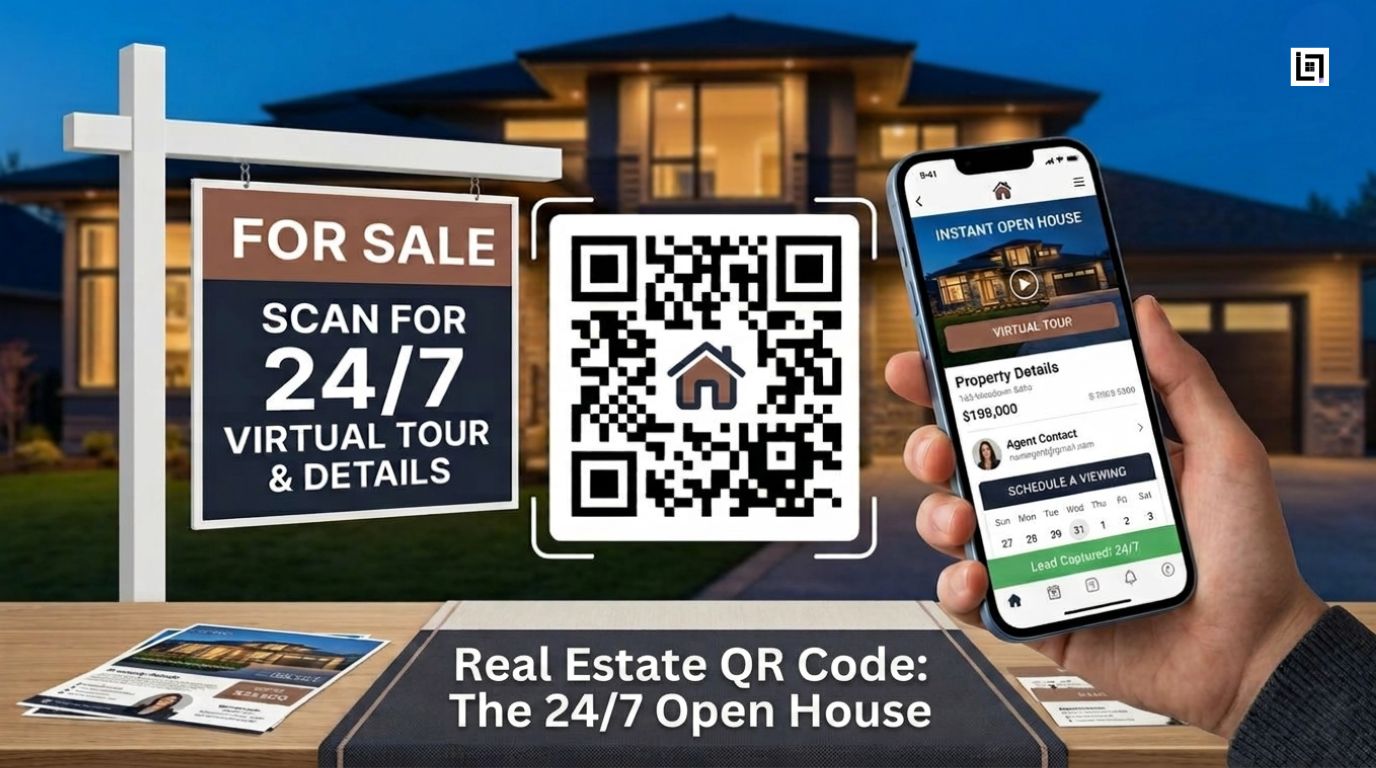

The real estate market moves fast. Really fast.
One moment you’re listing a property at a certain price. The next
moment – the market shifts, a buyer falls through, or the price drops.
What happens to all those paper brochures sitting in the plastic box on your yard sign?
They become completely useless.
Consequently, top-producing agents are shifting to digital tools. Specifically, they use an advanced real estate QR code to solve this problem.
This technology instantly bridges the gap between physical yard signs and online listings. By doing so, they replace unreliable paper with touchless tech. As a result, smart realtors can essentially host a 24/7 open house. They can capture high-intent buyer leads even while they sleep.
The brutal truth of modern real estate marketing is simple: printed flyers are often outdated by the time they are picked up.
The secret weapon behind this transformation? A highly organized, strategically deployed ecosystem powered by a modern real estate QR code generator.
Why Physical Print Fails the Modern Real Estate Cycle
Real estate signage hasn’t really changed in 30+ years. Here’s the
typical setup:
- A wooden or metal post
- Your brokerage logo
- Your phone number
- A plastic box stuffed with printed flyers
Sounds professional, right? Wrong.
Here’s what actually happens:
A buyer pulls up to the curb. They’re interested in the property. But the flyer they grab is:
- Rained on and warped
- Blown away by the wind
- Missing (never restocked)
- Outdated (price dropped yesterday, but the flyer still shows
the old price)
Worse, even if the flyer is pristine, it cannot show:
- A 4K drone walkthrough video
- An interactive 3D virtual tour
- A live map of local schools
- The ability to schedule a private showing instantly from the curb
And here’s the brutal truth: The moment a seller agrees to a price improvement or accepts a backup offer, every single sheet of paper in that box starts spreading misinformation to the public.
By implementing smart real estate QR codes directly into your signage architecture, you eliminate these friction points entirely. You instantly bridge the gap between physical property presence and digital lead capture.
The 4 Part Digital Property Hub Framework
Top real estate agents don’t just use a QR code. They use a
complete digital ecosystem that works together to capture leads and close deals.
Here’s the exact framework top-performing agents deploy:
1. The Instant Virtual Tour (PDF QR Code):
When a buyer stops at your yard sign or sees your listing online,
they want comprehensive details immediately.
A PDF QR code lets them scan and instantly download a beautiful
digital property packet on their phone.
This packet includes:
- Full color interactive floor plans (with exact room dimensions)
- High-end photography (interior and twilight exterior shots)
- Link to immersive 3D virtual tour (like Matterport)
- Property disclosures, tax records, and utility costs
- Neighborhood information and school ratings
Why it works: Once they download this to their phone, they carry
your branding and contact info with them for days. They’ll reference it multiple times before contacting you.
2. The On-Demand Showing (Schedule Viewing QR Calendar)
In real estate sales, speed-to-lead is everything. If a buyer falls in love with a property’s exterior aesthetic, you must strike while the iron is hot. They shouldn’t have to wait for a frustrating game of phone tag or an exchange of emails just to see the inside of the home.
By integrating a schedule-viewing QR calendar directly onto the sign or flyer, you route the prospect straight to your active booking portal (such as Calendly or your brokerage scheduling software). Qualified buyers can instantly view your available time slots, sync them with their schedules, and lock in a private showing appointment in seconds. This turns a passive viewer into a committed calendar event without requiring a single minute of manual coordination from your administrative team.
3. The Frictionless Lead Capture (Open House Real Estate QR Code)
We have all seen the classic open house clipboard: a piece of paper where visitors are asked to scrawl their names, email addresses, and phone numbers. Half of the handwriting ends up completely illegible, people leave fake information to avoid being contacted, and the agent has to manually type those messy details into a spreadsheet at the end of the weekend.
Modern teams use a dedicated open house QR code placed prominently at the entrance on an elegant acrylic table stand. This code links directly to a streamlined lead-generation QR code sequence or a mobile-optimized input form. Visitors securely type their info on their own devices to unlock entry or access the property’s digital disclosure packet. The data populates instantly, cleanly, and automatically into your CRM, triggering an immediate, pre-formatted text or email follow-up.
4. The Agent Portfolio Hub (Property Tour QR Link)
A single property listing is a fantastic asset, but it should also serve as a macro-marketing tool to build your personal brand and secure future listings. What happens if a buyer scans your yard sign, looks through the digital brochure, but realizes the home doesn’t have enough bedrooms or a large enough backyard for their needs?
If you only gave them a flyer for that specific house, your relationship ends there. However, by including a comprehensive property tour QR link that routes to an organized landing page (like a customized Linktree or agent portal), you open the door to your entire business. The prospect can immediately browse your other active inventory, read glowing client testimonials, review your recent sales data, or click a button to request a free home valuation for their own property.
Maximizing Conversion: Placement, Design, and Strategy
Simply generating a code and slapping it onto a poster is not enough to guarantee high conversion rates. To truly transform your business into a 24/7 lead-generation engine, you must treat your QR deployment with the same strategic care you give to your luxury staging.
Making Your QR Code Actually Get Scanned
Here’s the thing: Just putting a QR code on a sign isn’t enough.
A naked QR code, a random square with no context, rarely gets scanned.
People need to know what they’ll get.
The Critical CTA (Call-to-Action)
Your signage must explicitly state what happens when they scan.
Compare these:
Low Scans:
- Small code hidden in a corner with no text
- Code labeled simply “Website”
- Generic black-and-white square on a busy flyer
High Conversion:
- “Scan to See 3D Virtual Tour Right Now”
- “Scan to Check Current Price & Room Dimensions”
- “Can’t Make the Open House? Scan to Book a Private Tour”
- “Scan to Download Full Property Details”
The label should answer: “What do I get if I scan this?”
People want to know. Tell them.
Strategic Physical Positioning
Strategic Placement: Where Your QR Code Actually Gets Scanned
The best QR code in the world doesn’t work if people can’t reach it.
Think about your physical environment carefully:
For Drive-By Traffic
If your yard sign is set back 30 feet from the sidewalk, drivers can’t scan it from the road.
Solution:
- Use oversized QR code riders attached directly to your main
signpost (closer to the curb) - OR place a prominent code on a directional sign positioned right at curb level
This gives passing traffic a fighting chance to scan while driving by.
For Pedestrian Traffic (Urban/Downtown)
Pedestrians move more slowly and can pause, but they need accessibility.
Use:
- Window clings on condo listings and downtown office windows
- Neighborhood display boards for community attention
- Large printed codes on storefront displays where people
naturally pause
Let pedestrians comfortably hold up their phones and scan without the code being too high or too far away.
The ScanMyQR Advantage: Dynamic Control and Advanced Lead Analytics
In real estate, market conditions can shift dramatically over the course of a single afternoon. A beautiful property presentation matters, but the backend technology powering that presentation is what ultimately determines your operational efficiency. This is exactly why top-producing agents and teams rely on the ScanMyQR dashboard to power their foundational realtor marketing tools.
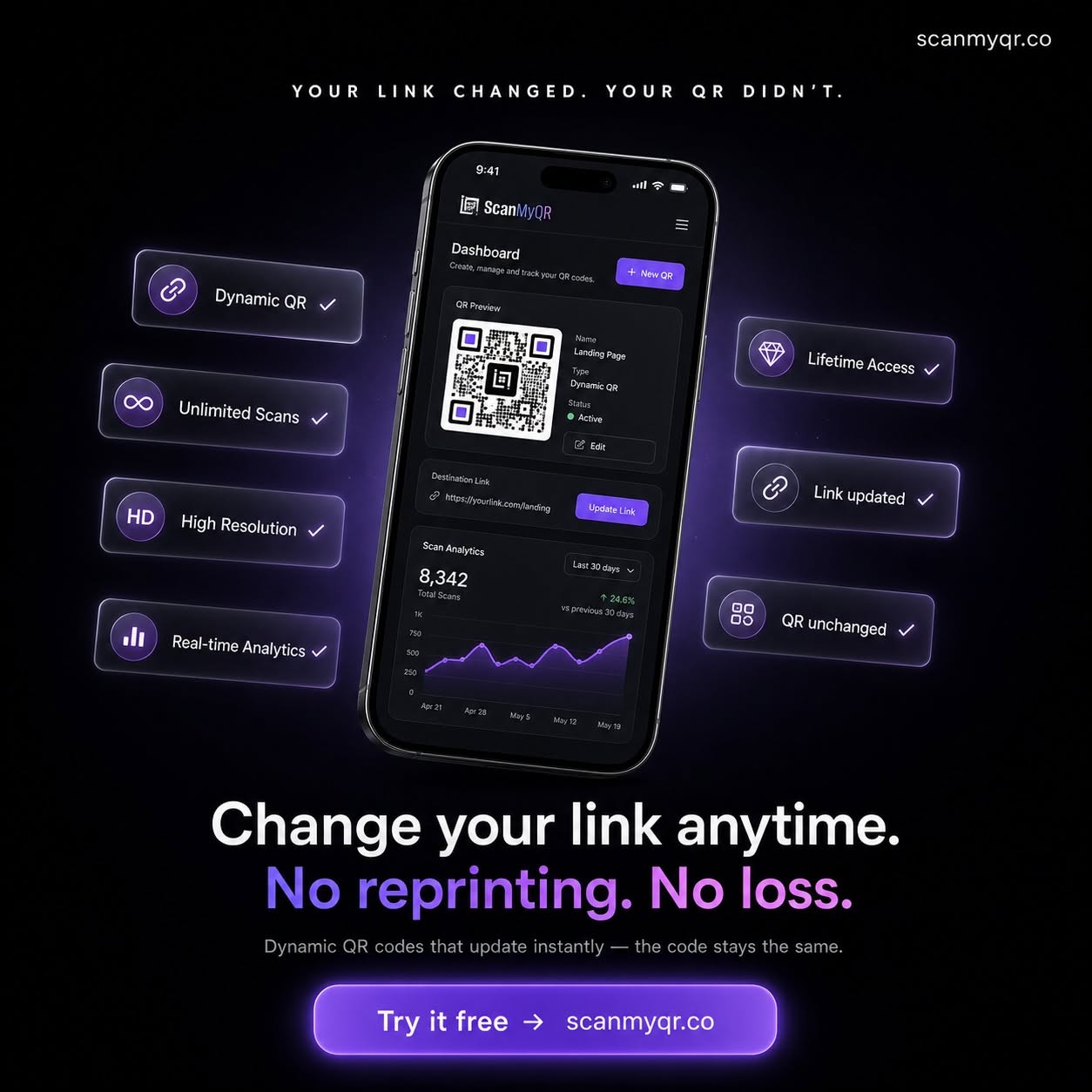
1. Zero-Print Dynamic Updates
The Game-Changer: Dynamic vs. Static QR Codes
Now that you understand how QR codes work in real estate, you need to pick the right type.
Static QR Codes (Free, Basic)
A static QR code has the destination permanently coded into the
design.
Good for:
- Free option
- Single, permanent property showing
- Doesn’t expire
Bad for:
- Can’t update the destination without reprinting
- Price drops? New listing? Under contract? You need new signs.
- No tracking data (can’t see who scanned, when, or from where)
Dynamic QR Codes (Paid, Professional)
A dynamic QR code uses a service like ScanMyQR to manage the
destination from a dashboard.
Good for:
- Update destination instantly (price drop → new link in 2 seconds)
- Property sells? Redirect buyers to your next listing
- Track detailed analytics (scans, time, location, device type)
- Change your calendar link without reprinting
- Manage dozens of codes from one dashboard
- Brand customization (your logo in the center, color matching)
Why do real estate agents prefer dynamic:
Imagine a property price drops $25,000. With a static code, you’d
need to:
- Generate new codes
- Send files to a print shop
- Drive to the property
- Replace all the signs
With a dynamic code, you:
- Log into your dashboard
- Update the destination URL
- Done (takes 30 seconds)
The same applies if the property goes under contract, if your showing calendar changes, or if you want to redirect to a new listing.
2. Real Estate Marketing Analytics: The Competitive Advantage
Here’s what separates successful agents from the rest: data.
When you use a dynamic QR code platform like ScanMyQR, you get detailed analytics that let you prove your marketing ROI to sellers.
What You Can See
Instead of guessing how many people saw your sign, you get:
- Scan count by date and time (“47 scans on Saturday 2-5 PM”)
- Geographic data (where scans are coming from)
- Device type (mobile device model)
- Next action (how many visited the virtual tour, booked a
showing, etc.)
Why Sellers Care
When you list a property, the seller wants to know: “Is my property
actually getting attention?”
With this data, you can tell them:
“Our street-facing yard sign generated 47 individual scans Saturday afternoon. Of those, 12 people downloaded the full property brochure and 3 booked private showings for next week.”
That’s proof. It’s professional. That’s why agents using analytics win more listings.
3. Scalable Portfolio Management
Eventually, your business scales from a solo agent to a top-tier team or a multi-office brokerage. When this happens, keeping track of dozens of marketing links can quickly become an organizational nightmare. The ScanMyQR platform allows you to manage agent QR codes systematically from a clean, unified dashboard.
First, you can easily categorize your codes by property address. In addition, you can organize them by specific marketing campaigns, such as mailers versus yard signs. Furthermore, this system allows you to apply consistent brand styling across the board. As a result, you can entirely eliminate ugly, generic black-and-white squares. Instead, you can customize every single asset with your brokerage’s precise signature color palette. Finally, you can seamlessly insert your clean corporate logo right into the center of the code.
The Real Estate Future Is Digital (And It’s Now)
The real estate industry is changing. Permanently.
Today’s buyers are mobile-first. They want:
- Information on their phone, instantly
- The ability to schedule showings without calling
- Virtual tours before they drive to the property
- No waiting for emails or phone callbacks
The buyers who buy homes in 2026 and beyond won’t pick up paper flyers.
They’ll scan codes.
The Choice Is Simple.
Old way: Expensive paper flyers that get rained on, blown away,
and become outdated within hours.
New way: A professional QR code ecosystem that:
- Works 24/7 (even while you sleep)
- Updates instantly (no reprinting costs)
- Captures leads automatically
- Tracks analytics (prove your ROI)
- Scales across your portfolio
Stop Losing Leads to Paper Flyers!
Paper brochures are outdated. They get rained on. They become wrong within hours. Buyers don’t pick them up anymore.
Real estate QR codes are the bridge between your physical sign and your digital presence!